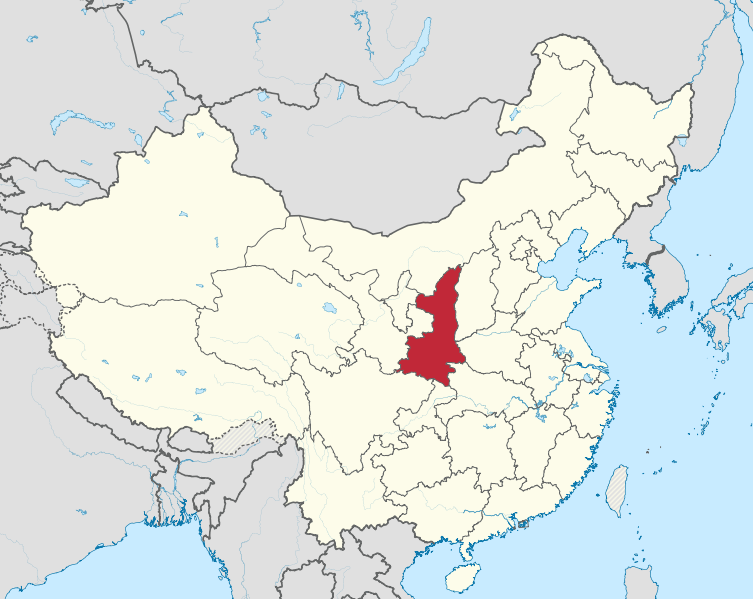
Shaanxi (陕西; Shǎnxī), pronounced roughly “Shahn-shee”, is a north-central province of China, and includes portions of the Loess Plateau on the middle reaches of the Yellow River as well as the Qinling Mountains across the southern part of the province.
The name Shaanxi means “Land west of Shan”. Shǎn was the ancient name for the narrow mountain pass where the Yellow River flows from the Loess Plateau down to the North China Plain. It is now known as Sanmenxia.
| Capital: | Xian – Capital city of Shaanxi Province, the start point of ancient Silk Road, most famed for its army of terracotta warriors. |
| Government: | Chinese Providence |
| Area: | 205,800 km2 |
| Population: | 37,327,378(2010 est) |
History
Shaanxi is considered one of the cradles of Chinese civilization. Thirteen feudal dynasties established their capitals in the province during a span of more than 1,100 years, from the Zhou Dynasty to the Tang Dynasty.
The province’s principal city and current capital, Xi’an, is one of the four great ancient capitals of China and is the eastern terminus of the Silk Road, which leads to Europe, the Arabian Peninsula and Africa.
Under the Han Dynasty, the Northern Silk Road was expanded to advance exploration and military purposes to the west. This Northern Silk Road is the northernmost of the Silk Roads and is about 2,600 kilometres (1,600 mi) in length. It connected the ancient Chinese capital of Xi’an to the west over the Wushao Ling Pass to Wuwei and emerging in Kashgar before linking to ancient Parthia.
Under the Ming dynasty, Shaanxi was incorporated into Gansu but was again separated in the Qing dynasty.
One of the most devastating earthquakes in history occurred near Hua Shan, in south-eastern part of Shaanxi Province on January 23, 1556, killing an estimated 830,000 people (see 1556 Shaanxi earthquake).
The end of the short-lived Jiangxi Soviet signalled the beginning of the Long March by Mao Zedong and the Chinese Communists to the Shaanxi Soviet at Yan’an.
Geography
The geography of the area is described as being part of the Ordos Desert in the north along the border with Inner Mongolia, the Loess Plateau in the central part of the province, the Qin Mountains (Qinling) running east to west in the south central part, and subtropical climate south of the Qinling. In between the Loess Plateau and the Qinling lies the Wei River Valley, or Guanzhong, a cradle of early Chinese civilization.
Going clockwise, Shaanxi borders Shanxi (E, NE), Henan (E), Hubei (SE), Chongqing (S), Sichuan (SW), Gansu (W), Ningxia (NW), and Inner Mongolia (N). In terms of number of bordering provincial-level divisions, Shaanxi ties Inner Mongolia.
Due to its large span in latitude, Shaanxi has a variety of climates. Under the Köppen climate classification, the northern parts, including the Loess Plateau, have either a cold arid (Köppen BWk) or cold semi-arid (Köppen BSk), with cold and very dry winters, dry springs and autumns, and hot summers. The area known as Guanzhong is mostly semi-arid, though there are a few areas with a humid subtropical climate (Köppen Cwa), with cool to cold winters, and hot, humid summers that often see early-season heatwaves. The southern portion is much more humid and lies in the humid subtropical zone, with more temperate winters and long, hot, humid summers. Annual mean temperature is roughly between 8 to 16 °C (46 to 61 °F), with January temperatures ranging from −11 to 3.5 °C (12.2 to 38.3 °F) and July temperatures ranging from 21 to 28 °C (70 to 82 °F).
Besides the provincial capital of Xi’an, other cities include: Baoji, Hanzhong, Lintong, Tongchuan, Xianyang, Yan’an and Ankang.
References
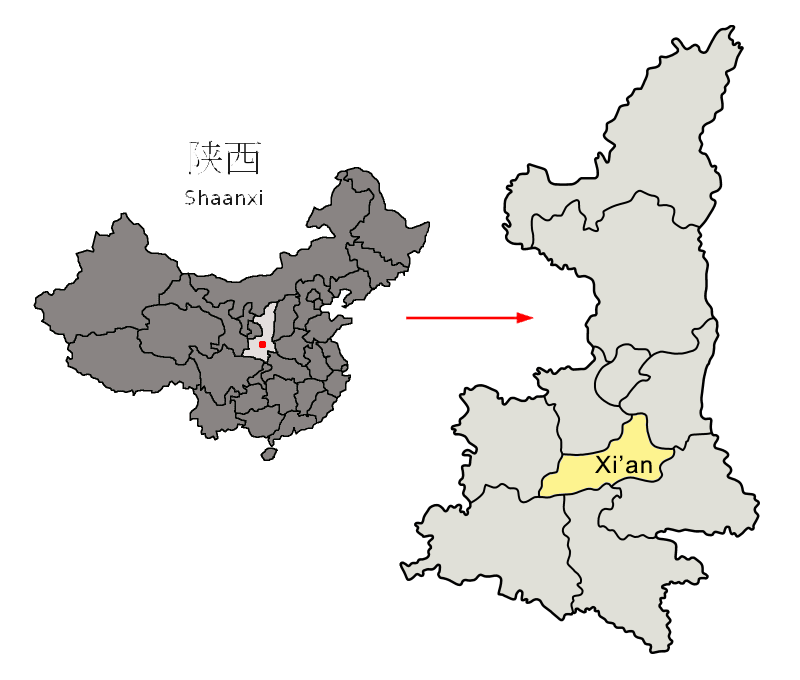
Xi’an ([ɕí.án]; Chinese: 西安), formerly romanized as Sian, is the capital of Shaanxi province, located in the northwest of the People’s Republic of China, in the center of the Guanzhong Plain. One of the oldest cities in China, the city was known as Chang’an before the Ming dynasty. Xi’an is the oldest of the Four Great Ancient Capitals of China (Beijing, Nanjing, Luoyang and Xi’an/Chang’an), having held the position under several of the most important dynasties in Chinese history, including Zhou, Qin, Han, Sui, and Tang. Xi’an is the starting point of the Silk Road and home to the Terracotta Army of Emperor Qin Shi Huang.
Since the 1990s, as part of the economic revival of interior China especially for the central and northwest regions, the city of Xi’an has re-emerged as an important cultural, industrial and educational centre of the central-northwest region, with facilities for research and development, national security and China’s space exploration program. Xi’an currently holds sub-provincial status, administering 9 districts and 4 counties. According to the 2010 Census, Xi’an has an urban population of 5,566,711 in its built-up area made of 7 out of 10 districts (all but Yanliang, Lintong and Gaoling not urbanized yet), while the total population of the Municipality is up to 8,467,837. It is the most populous city in Northwest China, as well as one of the three most populous cities in Western China.
The two Chinese characters “西安” in the name Xi’an mean “Western Peace”. During the Zhou dynasty, the area was called Fenghao, with the portion of the city on the west bank of the Feng River called Feng and the portion on the east called Hao. It was renamed Chang’an, meaning “Perpetual Peace”, during the Han dynasty (206 BCE–220 CE), although it was sometimes referred to as the Western Capital or Xijing (西京) during the Han dynasty after the capital was moved further east to Luoyang during Eastern Han. It changed in 581 CE to Daxing (大興) during the Sui dynasty then again became Chang’an from 618 during the Tang dynasty. During the Yuan dynasty (1270–1368), the city was first given the name Fengyuan (奉元), followed by Anxi (安西) then Jingzhao (京兆).
It finally became Xi’an in 1369 at the time of the Ming dynasty. This name remained until 1928, then in 1930 it was renamed Xijing (西京), or “Western Capital”. The city’s name once again reverted to its Ming-era designation of Xi’an in 1943.
History
Xi’an has a rich and culturally significant history. The Lantian Man was discovered in 1963 in Lantian County, 50 km (31 mi) southeast of Xi’an, and dates back to at least 500,000 years before the present time. A 6,500-year old Banpo Neolithic village was discovered in 1953 on the eastern outskirts of the city proper, which contains the remains of several well organized Neolithic settlements carbon dated to 5600–6700 years ago. The site is now home to the Xi’an Banpo Museum, built in 1957 to preserve the archaeological collection.
11th century BCE to 19th century CE
Xi’an became a cultural and political centre of China in the 11th century BCE with the founding of the Zhou dynasty. The capital of Zhou was established in the twin settlements of Fengjing (丰京) and Haojing, together known as Fenghao, located southwest of contemporary Xi’an. The settlement was also known as Zhōngzhōu to indicate its role as the capital of the vassal states. In 770 BC, the capital was moved to Luoyang due to political unrest. Following the Warring States period, China was unified under the Qin dynasty (221–206 BCE) for the first time, with the capital located at Xianyang, just northwest of modern Xi’an. The first emperor of China, Qin Shi Huang ordered the construction of the Terracotta Army and his mausoleum just to the east of Xi’an almost immediately after his ascension to the throne.
In 202 BCE, the founding emperor Liu Bang of the Han dynasty established his capital in Chang’an County; his first palace, Changle Palace (長樂宮, perpetual happiness) was built across the river from the ruin of the Qin capital. This is traditionally regarded as the founding date of Chang’an, or Xi’an. Two years later, Liu Bang built Weiyang Palace (未央宮, (perpetual happiness) hasn’t reached its midpoint yet) north of modern Xi’an. Weiyang Palace was the largest palace ever built on Earth, covering 4.8 km² (1,200 acres), which is 6.7 times the size of the current Forbidden City, or 11 times the size of the Vatican City. The original Xi’an city wall was started in 194 BCE and took 4 years to finish. Upon completion, the wall measured 25.7 km (15.97 mi) in length and 12 to 16 m (39.37–52.49 ft) in thickness at the base, enclosing an area of 36 km2 (13.90 sq mi). In the year 190, amidst uprisings and rebellions just prior to the Three Kingdoms Period, a powerful warlord named Dong Zhuo moved the court from Luoyang to Chang’an in a bid to avoid a coalition of other powerful warlords against him.
Following several hundred years of unrest, the Sui dynasty united China again in 582. The emperor of Sui ordered a new capital to be built southeast of the Han capital, called Daxing (大興, great prosperity). It consisted of three sections: the Imperial City, the palace section, and the civilian section, with a total area of 84 km2 (32 sq mi) within the city walls. At the time, it was the largest city in the world. The city was renamed Chang’an (長安, Perpetual Peace or Eternal Peace) by the Tang Dynasty. In the mid-7th century, after returning from his pilgrimage to India, Buddhist monk Xuanzang (popularly known as Tang Sanzang) established a translation centre for Sanskrit scriptures.
Construction of the Great Wild Goose Pagoda began in 652. This pagoda was 64 m (209.97 ft) in height, and was built to store the translations of Buddhist sutras obtained from India by Xuanzang. In 707, construction of the Small Wild Goose Pagoda began. This pagoda measured 45 m (147.64 ft) tall at the time of completion, and was built to store the translations of Buddhist sutras by Yijing. The massive 1556 Shaanxi earthquake eventually damaged the tower and reduced its height to 43.4 m (142.39 ft).
Chang’an was devastated at the end of the Tang dynasty in 904. Residents were forced to move to the new capital city in Luoyang. Only a small area in the city continued to be occupied thereafter. During the Ming dynasty, a new wall was constructed in 1370 and remains intact to this day. The wall measures 11.9 km (7.4 mi) in circumference, 12 m (39.37 ft) in height, and 15 to 18 m (49.21–59.06 ft) in thickness at the base; a moat was also built outside the walls. The new wall and moat would protect a much smaller city of 12 km2 (4.6 sq mi).
20th century and after
In October 1911, during the revolution in which the Qing dynasty was overthrown, the Manchus living in the northeastern zone within the city walls were massacred. In 1936, the Xi’an Incident took place inside the city during the Chinese Civil War. The incident brought the Kuomintang (KMT) and Communist Party of China to a truce in order to concentrate on fighting against the Japanese Invasion. On May 20, 1949, The Communist-controlled People’s Liberation Army captured the city of Xi’an from the Kuomintang force.
Geography
Xi’an lies on the Guanzhong Plain in the south-central part of Shaanxi province, on a flood plain created by the eight surrounding rivers and streams. The city has an average elevation of 400 metres (1,312 ft) above sea level and an annual precipitation of 553 mm (21.8 in). The urban area of Xi’an is located at 34°16′N 108°56′E. The Wei River provides potable water to the city.
The city borders the northern foot of the Qin Mountains (Qinling) to the south, and the banks of the Wei River to the north. Hua Shan, one of the five sacred Taoist mountains, is located 100 km (62 mi) away to the east of the city. Not far to the north is the Loess Plateau.
At the beginning of Han dynasty, Prime Minister Zhang Liang advised the emperor Liu Bang to choose Guanzhong as the capital of the Han dynasty: ‘Guanzhong Plain, which is located behind Xiao Pass and Hangu Pass, connects Long (Gansu) and Shu (Sichuan). Land of thousands miles and rich in harvest can be found here, as if this place is belongs to the nation of the heaven. (《关中左崤函,右陇蜀,沃野千里,此所谓金城千里,天府之国也》) Since then, Guanzhong is also known as the »Nation of the Heaven«.
Climate
Xi’an has a temperate climate that is influenced by the East Asian monsoon, classified under the Köppen climate classification as situated on the borderline between a semi-arid climate (BSk) and humid subtropical climate (Cwa). The Wei River valley is characterised by hot, humid summers, cold, dry winters, and dry springs and autumns. Most of the annual precipitation is delivered from July to late October. Snow occasionally falls in winter but rarely settles for long. Dust storms often occur during March and April as the city rapidly warms up. Summer months also experience frequent but short thunderstorms. The monthly 24-hour average temperature ranges from around the freezing mark in January to 26.6 °C (79.9 °F) in July, with an annual mean of 13.68 °C (56.6 °F). With monthly percent possible sunshine ranging from 31 percent in December to 47 percent in August, the city receives 1,646 hours of bright sunshine annually. Extreme temperatures have ranged from −20.6 °C (−5 °F) to 42.9 °C (109 °F)
References
Xi’an City Center is the area inside the city walls.
City Wall
When Zhu Yuanzhang, the first Emperor of the Ming Dynasty (1368-1644), captured Huizhou, a hermit named Zhu Sheng admonished him that he should ‘built high walls, store abundant food supplies and take time to be an Emperor,’ so that he could fortify the city and unify the other states. After the establishment of the Ming dynasty, Zhu Yuanzhang followed his advice and began to enlarge the wall built initially during the old Tang Dynasty (618 – 907), creating the modern Xian City Wall. It’s the most complete city wall that has survived in China, as well being one of the largest ancient military defensive systems in the world.
After the extension, the wall now stands 12 meters (40 feet) tall, 12-14 meters (40-46 feet) wide at the top and 15-18 meters (50-60 feet) thick at the bottom. It covers 13.7 kilometers (8.5 miles) in length with a deep moat surrounding it. Every 120 meters, there is a rampart which extends out from the main wall. All together, there are 98 ramparts, which were built to defend against the enemy climbing up. Each rampart has a sentry building, in which the soldiers could protect the entire wall without exposing themselves to the enemy. Besides, the distance between every two ramparts is just within the range of an arrow shot from either side, so that they could shoot the enemy, who wanted to attack the city, from the side. On the outer side of the city wall, there are 5,948 crenellations, namely battlements. The soldiers can outlook and shoot at the enemy. On the inner side, parapets were built to protect the soldiers from falling off.
Since the ancient weapons did not have the power to break through a wall and the only way for an enemy to enter the city was by attacking the gate of the city wall. This is why complicated gate structures were built within the wall. The wall includes four gates and they are respectively named as Changle (meaning eternal joy) in the east, Anding (harmony peace) in the west, Yongning (eternal peace) in the south and Anyuan (forever harmony) in the north.
The south gate, Yongning, is the most beautifully decorated one. It is very near to the Bell Tower, center of the city. Important greeting ceremonies organized by the Provincial Government are usually held in the south gate square. The South Gate Square is restored and formally open to public on September 6, 2014. Covering an area of around 7.9 acres (32,000 square meters), the U shaped square is divided into three parts, main royal road, secondary royal road and celebration square. Below the square is a large underground parking lot. Meanwhile, two museums inside the barbican and the archery tower of the South Gate are also open to the public. Tourists who visit the wall can enjoy a free visit to these two museums.
Each city gate has three gate towers: Zhenglou, Jianlou and Zhalou. The most outside is Zhalou, which stands away and is opposite to Zhenglou. It was used to raise and lower the suspension bridge. Jianlou with small windows in the front and flanks was used as a defensive outpost. Zhenglou, in the inner, is the main entrance to the city. The wall connects Jianlou and Zhenglou Towers. The area between them was called ‘Wong Cheng’, in which the soldiers stationed. From Wong Cheng, there are sloped horse passages leading to the top of the wall.
Initially, the city wall was built with layers of dirt, with the base layer including also lime and glutinous rice extract. Throughout the time the wall has been restored three times. In 1568, Zhang Zhi (the government officer of that period) was in charge to rebuild the wall with bricks. In 1781, another officer, Bi Yuan, refitted the wall and the gate towers. More recently (since 1983) the Shaanxi Provincial Government restored the wall again. The circular City Wall Park has been built along the high wall and the deep moat. The thriving trees and flowers decorate the classical Chinese architecture of the wall, adding additional beauty to the city of Xian.
Travel Tips for Ascending the wall
Encircling the rectangled city center of Xian, it has totally 18 city gates, but they are not all open for visitors. Visitors can ascend the Wall from the South Gate, Small South Gate, East Gate, West Gate, North Gate, Heping Gate, Wenchang Gate and Hanguang Gate. You can choose the nearest city gate according to your location. No matter which gate you choose, you can tour the whole circle of the wall if you like. Here is a hiking itinerary around the wall starting from the South Gate for your reference.
The South Gate (Yongning Gate) is the most time-honored and magnificent one among all the city gates. There is bicycles for rental up to the South Gate. So it is popular for visitors to ascend here. If you stay near the Bell Tower, it is recommended that you take a 10 minutes’ walk along the South Street to get to the South Gate.
City Wall Hiking Guide
Standing amidst a myriad of modern buildings, China’s most integrated and best-preserved Ming dynasty City Wall has long been a widely admired landmark for visitors to Xian. Here we present you with a hiking route along the wall that will teach you about warfare, city construction and the architectural arts in ancient times. And it’ll be fun, too!
Let’s start by hiking from the South Gate (also called Yong Ning Gate, meaning eternal peace), which is the most time-honored gate among the four main gates (one for each side of the wall). For almost all Chinese dynasties, the south gate of a royal capital was always the site to greet distinguished guests. Those statues of the ancient dancing ladies, the red palace lanterns and the colorful flags in the South Gate square show that this old city still welcomes visitors from afar. You can buy an admission ticket at the north end of the square to get across the suspension bridge and the Zhalou, namely the gate tower outside of the city wall. There is also a ticket office right below the Zhenglou gate tower on the other side of the main city wall for visitors who come from the inner city. After mounting the wall and viewing the surrounding scenery, you will be surprised at how well the modern buildings fit in with the old architecture such as the wall and the Bell Tower.
On your way westward, you might notice that there are ramparts, which extend out from the main wall. The ramparts were originally built every 120 meters with a sentry building on top to shoot any attackers who climbed the wall. This interval was not decided by accident, but by the fact that half the distance between two ramparts was the effective range of ancient weapons like the bow and arrow and crossbow. After walking about 1,050 meters, you will reach Zhu Que Gate. As one of the four divine creatures in ancient China, Zhu Que (rose finch) symbolizes the southern direction and the season of summer. Therefore, Zhu Que Gate was the south gate of the original city wall in the Sui and Tang dynasties, and the emperors usually held important ceremonies here. In 645AD, when the renowned Monk Xuan Zang returned to Chang’an (the ancient name for Xian) from his arduous seventeen-year journey to India via the ancient Silk Road, he was warmly greeted at the Zhu Que Gate by the chancellor, Fang Xuanling, and other high officials who were instructed to represent Emperor Taizong of the Tang dynasty. According to historical materials, Japan’s first imperial court in Nara was modeled after Chang’an city, and it had a replica of Zhu Que Gate as the main entrance, so one can imagine how famous and grand the gate once was. The original Zhu Que Gate was destroyed during a battle at the end of the Tang dynasty. The current one was built in the 1980s very near to the ruins of the original and is of great historical importance. It is now a major gateway to and from the city center.
Further to the west of the Zhu Que Gate, you can see the Wumu Gate, commonly known as the Small South Gate. It was opened in 1939 to commemorate Mr. Jin Wumu, an early outstanding member of Tongmenhui (Chinese Revolutionary League) who died a martyr during the bourgeois revolution of 1917. If you hike along the wall in the morning, you might see the busy early morning market, an indispensable part of the everyday life of the local people.
The next few meters walking to the southwest corner of the city wall, you will pass the Han Guang Gate, which is the best-preserved site of the capital Chang’an during the Sui and Tang dynasties (581 – 907). Here you can get down to the Han Guang Gate Site Museum to explore an array of relics, and the inner structure and the history of the city wall. You may also take a side visit to China’s first thematic museum, focusing on calligraphy, located nearby. Neither of the two museums requires an extra admission fee.
As you pass along the city wall, you can see a belt of recreational parks on its outside fringe. This belt is called Round-the-City Park. Of all these parks, the West Park is the largest extending more than 3 kilometers, from the southwest corner of the city wall to the northwest corner. It is open to the public for free and has fitness equipment, leisure facilities, lush trees, wide lawns, and ancient style buildings. Here you could observe the everyday life of the locals doing morning exercises, taking a leisure walk with their pet birds, playing table tennis, singing Shaanxi Opera, or just basking in the sun.
Walking north for about 850 meters from the southwest corner, you will arrive at the West Gate. In the past, it was called An Ding Gate meaning that the western frontier is harmonious and peaceful. Set up in 1374-1378 during the Ming Dynasty, the West Gate has all three of its gate towers, Zhalou, Jianlou (arrow tower) and Zhenglou, in a well-preserved state. With square windows (namely arrow holes) in the front and on both sides, the Jianlou tower, located between Zhalou tower and Zhenglou tower, formed another important defense line to guard the city gate. East of the Zhenglou tower, you can see a series of Tang-style buildings stretching out ahead of you all the way to the Drum Tower and Bell Tower. There is a viewing station north of the tower for visitors to better appreciate the imposing wall.
The next stop is Yu Xiang Gate, which is about 1260 meters north of the West Gate. In 1926, Xian city was besieged by the warlord Liu Zhenghua for more than eight months, during which time many of civilians and soldiers perished in the fighting and from disease and starvation. The city was not saved until General Feng Yuxiang and his National Revolutionary army defeated Liu Zhenghua. In 1928, this gate was opened in memory of General Feng Yuxiang. A series of city sculptures – Zhang Qian’s Diplomatic Mission to the Western Regions – stands at the square outside Yu Xiang Gate. Inside the gate, is Lianhu Road, one of the busiest east-west traffic arteries.
About 560 meters further north of the Yu Xiang Gate is the northwest corner of the City Wall. There, a Sentry Building, which was important to the inner city’s safety, stands capturing visitors’ attention. Right inside the corner is the only Lama temple in Xian, the Guangren Temple, which was built in 1703 when Emperor Kangxi came to Chang’an (Xian) during the Qing dynasty. From then on, it played a significant role in promoting national solidarity. With imposing white pagodas outside, stately buildings, leafy trees and flowers inside, the temple today is a nice quiet area in the bustling city.
After walking eastward for about 700 meters, you will reach the Shang Wu Gate (Small North Gate). Inside the gate there is a street called Xiwuyuan, which, as the name implies, was a place in the past to practice martial arts. The Shaanxi military and Kung Fu examinations were held in Xiwuyuan during the Sui and Dang dynasties. It was also the parade ground for military training during the Qing dynasty.
If you walk east for 1440 meters you can see the North Gate. Also called An Yuan Gate, it implied that the imperial court hoped all its conciliatory approaches towards the minorities on the north frontier would lead to peace. When the 1911 Revolution broke out, the original North Gate towers, where the Qing Army had ammunition stored, were destroyed in the heavy fighting. The current gate was restored in 1983, and it has some cultural relics and works of calligraphy and painting on display in the arrow tower. You can feel proud that half the distance of your city wall hike has been completed.
In the next 2300 meters walking eastward to the northeast corner, you will pass the Shang De Gate, Jie Fang Gate, Shang Jian Gate and Shang Qin Gate. These four gates are all busy traffic arteries leading to the Xi’an railway station. The Shang De Gate, Shang Jian Gate and Shang Qing Gate were all opened after the founding of new China. Together with the Shang Wu Gate, they all evince the virtues of Confucian ethics. The original Jie Fang Gate was opened during the Republic Period and was torn down in 1952 to expand the railway square. The current rebuilt one joined the entire wall together in 2005.
Next you will reach the Chao Yang Gate by walking about 780 meters, after rounding the corner. Facing towards the sun, this gate is the first one kissed by the rays of sunshine every day, so that’s where it gets its name.
It is the Zhong Shan Gate (Small East Gate) that is 820 meters south of the Chao Yang Gate. The opening of this gate was sponsored by General Feng Yuxiang in honor of Dr. Sun Yat Sen, the greatest revolutionary forerunner of modern China. Inside the Zhong Shan Gate, there is a thriving antiques market. You can get down from the wall and finish the hiking from this gate if you are interested in exploring or collecting antiques.
You will see the East Gate after walking southward for 700 meters. It has been called Chang Le Gate (eternal joy) since the Ming dynasty. As Nanjing, the Ming capital, was east of Xian, this gate was named to proclaim the wish that the Ming Emperors desired their government to endure forever at ease. In October of 1643, Li Zicheng led his peasant rebellion force and stormed their way into the inner city from this gate. When he saw the horizontal tablet on the gate, he said to his army ‘what a miserable life for people if the emperor wants eternal joy’, so they indignantly burnt up the gate. It was rebuilt during the Qing dynasty, and today you can see old defenses like cannons and ballista here.
Walking the next 1020 meters, you will round the southeast corner of the wall and move westward to arrive at the Jian Guo Gate, which was opened to mark that great historic event, the founding of PRC.
While enjoying the city views, you will see the He Ping Gate. The name showed the war-weary Chinese people’s deep desire for peace in the early years after liberation. Casting your eyes south to the end of the street, the Big Wild Goose Pagoda is visible.
The next stop, Wen Chang Gate, is about 640 meters on your way westward. There is a tower honoring the god of literature, the only construction that has nothing to do with military defense. Legend has it that scholars and students worshipped the god of literature for inspiration and academic help before examinations. The ancients believed that if one’s name could be selected by the god of literature, he would pass the three imperial examinations and became the top candidate. Getting down from the Wen Chang Gate and walking inside it for a short while, you can find the Forest of Stone Steles Museum and the site of Guanzhong Shuyuan (the Central Shaanxi Academy – the highest educational institution of Shaanxi Province during the Ming and Qing dynasties). East of the Forest of Stone Steles Museum, there is a 570 meter-long ancient culture street, which is called Shuyuanmen because of the Guanzhong Shuyuan. Those stores sell a lot of calligraphy, paintings, writing brushes, ink stick, paper and ink slabs making this street very culturally active.
If you are still on the wall, you can find that success is in sight. It takes only about 605 meters walking further west to your starting point, the South Gate. At this moment, you will feel a strong sense of accomplishment after finishing this 13-kilometer hike. Congratulations!
Muslim Quarter
Just as its name implies, the Mulim Quarter is the hub of the Muslim community in Xian City, Shaanxi Province. Located to the north of the West Street in the city center, the quarter covers several blocks inhabitated by over 20,000 Muslims. There are about ten mosques in this area, among which the Great Mosque in the Huajue Lane is the most famous and popular.
Muslim food and souvenir market is another feature of the area. The Beiyuanmen Muslim Market located just to the north of the Drum Tower is a great choice after the sightseeing in the city center. About 500 meters (about 547 yards) in length from south to north, the street can be reached through the archway under the Drum Tower. This street is paved with dark colored stone with green trees providing heavy shade during summer; the buildings on both sides of the street are modeled on the styles of both the Ming (1368-1644) and the Qing Dynasties (1644-1911). Some of the constructions are restaurants; while others are stores. But here there is one thing in common: the owners are all Muslims.
Walking along this twisted, narrow street which is aligned with stores on both sides, you can see that Muslim men with white hats sit inside the stores and talk leisurely with each other. Artwork stalls in Muslim QuarterIn front of the doors of some stores, old men with white beards sit on the cane chairs enjoying the tender touch of the sun and having fun with the little children running along the street. The main goods of these stores are authentic hand-making Muslim food which tastes very good. While still there are small stores selling the special local products of Shaanxi Province and yet others provide you with exquisite souvenirs.
It is stated that once you have been to the Beiyuanmen Muslim Street, you won’t feel regretted for the snacks of Xian. Crumbled Unleavened Bread in Mutton Stew (Yangrou Paomo) is a very distinctive snack of Xian, and is extremely delicious. Fried rice with pickled Chinese cabbage and little capsicum is extremely savoury. And it is a real enjoyment for you to eat it on a hot summer’s day. Roast beef, mutton or lamb is another snack that can make your mouth water. After broiling on a charcoal fire with some flavorings on the meat, it is ready for you to enjoy. While the most famous snack on this street is the steamed stuffed bun of Jiasan. The main ingredients of the steamed stuffed bun here are beef or mutton mixed with the soup decocted from the bones of sheep or cattle.
There are also fruit pies made with persimmon here which are considered as the unique refreshment in Xian. These pies take the bright red, glittering and translucent persimmons from the Lintong District of Xian City, Shaanxi Province as the basic ingredients. When making the pies, firstly people will get rid of the skin of the persimmons, pounding the flesh, mixing it with flour, then putting the sweet-scented osmanthus and white sugar inside as the stuffing, then frying them in oil until they are cooked. When eating them, you will feel savory, sweet and soft.
There are also a great many other snacks to be found along this street, such as preserved meat, casserole, various noodles, and so on. They are waiting for you to enjoy.
Great Mosque
The Great Mosque in Xian is one of the oldest, largest and best-preserved Islamic mosques in China and its location is northwest of the Drum Tower (Gu Lou) on Huajue Lane.
According to historical records engraved on a stone tablet inside, it was built in 742 during the Tang Dynasty (618-907). This was a result of Islam being introduced into Northwest China by Arab merchants and travelers from Persia and Afghanistan during the mid-7th century when some of them settled down in China and married women of Han Nationality. Their descendants became Muslim of today. The Muslim played an important role in the unifications of China during the Yuan and Ming Dynasties. Hence, other mosques were also built to honor them.
In Xian, it is really well worth a trip to see the Great Mosque, not only for its centuries-old history but also for its particular design of mixed architecture – traditional Muslim and Chinese styles.
Occupying an area of over 12,000 square meters, the mosque is divided into four courtyards, 250 meters long and 47 meters wide with a well-arranged layout. Landscaped with gardens, the further one strolls into its interior, the more serene one feels.
The first courtyard contains an elaborate wooden arch nine meters high covered with glazed tiles that dates back to the 17th century. In the center of the second courtyard, a stone arch stands with two steles on both sides. On one stele is the script of a famous calligrapher named Mi Fu of the Song Dynasty; the other is from Dong Qichang, a calligrapher of the Ming Dynasty. Their calligraphy because of such elegant yet powerful characters is considered to be a great treasure in the art of handwriting.
At the entrance to the third courtyard is a hall that contains many steles from ancient times. As visitors enter this courtyard, they will see the Xingxin Tower, a place where Muslims come to attend prayer services. A ‘Phoenix’ placed in the fourth courtyard, the principal pavilion here, contains the Prayer Hall, the surrounding walls of which are covered with colored designs. This Hall can easily hold 1,000 people at a time and according to traditional custom, prayer services are held five times everyday respectively at dawn, noon, afternoon, dusk and night.
In China, this Great Mosque is the only one open to visitors from 8 a.m. to 7:30 p.m. Non-Muslims, however, are not admitted to the main prayer hall or during times of prayer.
Drum Tower
The Drum Tower is located northwest of the Bell Tower of Xian, across the Bell and Drum Tower Square. Both of them are called the ‘sister buildings’ or ‘morning bell and dark drum’. In ancient China, especially from the Yuan Dynasty (1271-1368), the drums were used to signal the running of time and on occasion were used as an alarm in emergency situations.
It was initially built in 1380 during the reign of Emperor Hongwu of the Ming Dynasty (1368-1644), and was renovated twice in 1699 and 1740 in the Qing Dynasty (1644-1911). It is a two-storied post and panel structure, 34 meters (about 112 feet) high and 52.6 meters (about 172 feet) long from east to west as well as 38 meters (about 124 feet) wide from north to south. The architecture style of the Drum Tower is a combination of the styles of the Tang Dynasty (618-907) and the Qing Dynasty. However, it also has some innovative features. For example, it should be mentioned that there is no iron nail used anywhere in the Tower.
Upon arrival you will see that there is an arched doorway in the centre of the south and north walls, doorway being 6 meters (about 20 feet) in both height and width. The north entrance leads to Beiyuan Men and south to the West Avenue. Visitors can go upstairs to the second floor, and enjoy the views around the Drum Tower. Meanwhile, you will notice that there are twenty-four drums in its north and south sides. They stand for the Twenty-four Solar Terms which is a kind of weather calendar created by the Chinese ancients in order to guide the agricultural production.
In modern times, the Drum Tower is not used as a timer any more, but there are some new attractions for visitors to enjoy. In the year of 1996, a new drum, covered by a whole piece of cowhide was given a place on the Tower. It is the biggest drum in China at present. What is more, visitors will enjoy musical performances inside it. These performances will enlighten one on the power of ancient Chinese culture.
When you finish visiting the Tower, you may round off your trip, by tasting a number of delicious snacks of Shaanxi in the Muslim Quarter adjacent to it.
Bell Tower
The Bell Tower, is a stately traditional building, that marks the geographical center of the ancient capital. From this important landmark extend East, South, West and North Streets, connecting the Tower to the East, South, West and North Gates of the City Wall of the Ming Dynasty.
The wooden tower, which is the largest and best-preserved of its kind in China, is 36 meters (118 feet) high. It stands on a brick base 35.5 meters (116.4 feet) long and 8.6 meters (28.2 feet) high on each side. During the Ming Dynasty, Xian was an important military town in Northwest China, a fact that is reflected in the size and historic significance.
The tower was built in 1384 by Emperor Zhu Yuanzhang as a way to dominate the surrounding countryside and provide early warning of attack by rival rulers.
It has three layers of eaves but only two stories. Inside, a staircase spirals up. The grey bricks of the square base, the dark green glazed tiles on the eaves, gold-plating on the roof and gilded color painting make the tower a colorful and dramatic masterpiece of Ming-style architecture. In addition to enhancing the beauty of the building, the three layers of eaves reduce the impact of rain on the building.
On the second floor, a plaque set in the west wall records the relocation of the tower in 1582. When it was first built in 1384, it stood near the Drum Tower of Xian on the central axis of the city, and continued to mark the center of the city since Tang Dynasty and the following the Five Dynasties and the Song and Yuan Dynasties. As the city grew, however, the geographical center changed. Therefore, in 1582, the Tower was moved 1,000 meters (3,280 feet) east of the original site. Except for the base, all parts are original, and history tells us that the relocation was accomplished quickly and inexpensively, making it a truly notable achievement in the architectural history in China.
Originally, the northwest corner of the tower housed the famous Jingyun Bell from the Tang Dynasty. Legend has it that although nothing had happened here, the Jingyun Bell fell silent during the Ming Dynasty, so the current bell, a much smaller one weighing only 5 tons, was cast. The original one can now be seen in Forest of Stone Steles Museum.
The engravings on the doors reflect the decorative fashion of Ming and Qing Dynasties, recounting popular stories of ancient China.
On each side of the base, there is an arched door 6 meters (19.6feet) high. In the past, vehicles were allowed to pass through the arches, but as the city has grown the volume of traffic has become too great, so a bright, spacious pedestrian subway has been constructed under the tower. The entrance to the tower is from this subway.
A fenced-in area around the tower is planted with grass and flowers. In early spring, the tender plum blossoms and bright new grass surrounding provide a harmonious contrast. Not far from the Tower, modern shopping malls and a brightly decorated square reveal the prosperity of the city. When night falls, lanterns hung from the eaves illuminate the tower, making it even more enchanting.
The Bell Tower definitely deserves a visit on your trip to Xian.
Forest of Stone Steles Museum
The Forest of Stone Steles Museum is also called the Steles Forest or Beilin Museum, is a themed museum focusing on displays of stone steles, epigraphs and stone sculptures from past dynasties. Its location is on Sanxue Street, inside the Wenchang Gate of the Xian City Wall. Its construction is based on Xian Confucius Temple dating from 1087 during the North Song Dynasty (960 – 1127). The museum was built to preserve the Kaicheng Classics (a group of stone tablets) and the Filial Piety Classics. The collection has grown and now includes 11,000 relics, including three thousand stone steles or epigraphs that are housed in seven separate exhibition rooms. Among these many precious relics, there are 19 groups deemed to be national treasures that the visitor should not fail to see.
Compared with other museums, the outstanding characteristic of the Forest of Stone Steles Museum is its collection of inscribed tablets. Tablet inscriptions tell us about the religions, life styles and historical facts of ancient times in a vivid way. They provide tourists with a grasp of the general outline of Chinese history and the interaction of China and other countries. For the fans of Chinese calligraphy, these inscriptions are of great interest as they are fine examples of the diverse styles of Chinese characters.
The museum is divided into two parts by the Halberd Gate, with the old constructions in the Confucius Temple in front and the exhibition rooms at the back. Upon arrival, the site of the Confucius Temple, including the screen wall, memorial archway and the Lingxing Gates, is before you. Through the Halberd Gate, two separate pavilions are arranged one on either side, with a stone horse of Daxia State (a minority ethnic state from 407 to 431) on the north side and a bell made in Tang Dynasty (618 – 907) on the south. The stone horse is a national treasure as it is rare and in the style of the Han Dynasty (206 BC – 220 AD).
As you go forward you pass by six pavilions and several temporary exhibition rooms arranged along a narrow path. At present, all these pavilions are closed to the public. At the end of this path there is a pavilion where the Stone Tablet of Classic Filial Piety is displayed. This was carved during the Tang Dynasty and bears inscription of dialogues between Confucius and his students.
Seven Exhibition Rooms for Steles
The first room is just behind the Stone Tablet of Classic of Filial Piety. The major exhibits in this room are the Kaicheng Classics, carved in 837 AD during the Tang Dynasty. This is a group of stone tablets with 12 reading books for intellectuals inscribed on them. Ancient Chinese people carved such books in stone to prevent copying errors and thereby provided models by which students could check the accuracy of reproduced texts. The Kaicheng Classics are the best preserved set of classics on stones in China.
The second room collects stone tablets focusing on Chinese calligraphy of the Tang Dynasty. Most of these are examples used by those learning calligraphy today. The Nestorian Stele and the Bukong Monk Stele in this room are valuable sources for the study of intercultural communications between China and foreign countries during the Tang Dynasty.
In the third room, stone tablets of calligraphy in other dynasties from the Han Dynasty to the Song Dynasty (960 – 1279) are on display. These focus mainly on various styles of Chinese calligraphy such as seal characters and regular script. For instance, the Stone Tablet of Cao Quan focuses on the clerical script and the Duobao Pagoda Stele and Xuanmi Pagoda Stele are the representatives of the regular script.
The fourth room houses stone tablets inscribed with poems and the likenesses of many of the calligraphers from the period as well as historical information. Most of these were carved during the reigns of the Song Dynasty to Qing Dynasty (1644 – 1911). In addition, many pictures of ancient palaces and natural landscapes are sculpted on the tablets. The stone picture of Xingqing Palace inscribed in Song Dynasty and the picture of Eight Views of Guanzhong Plain ( in central Shaanxi) carved in Qing Dynasty can be found in this room.
In the fifth room, most of the stone steles carved in Qing Dynasty, have local historical information from different places engraved on them. This is valuable not only for calligraphers but also historians. The historical information includes such topics as local history, society and records detailing the construction of temples, cities and so on.
In the sixth room, most of the stone steles have poems, written in Qing Dynasty, carved on them, which are very hard to obtain. You can even see stone steles written by Emperor Kangxi, the fourth Qing Dynasty emperor, and Lin Zexu, a national hero of the Qing Dynasty.
In the last room, the seventh is where a replica of The Secret Copybooks of Chunhua is kept. The original Secret Copybooks of Chunhua, engraved in the year of Chunhua (992 AD) during the Song Dynasty, was a group of date-wood boards bearing calligraphy written by emperors, famous ministers and other skilled calligraphers. These copybooks were destroyed in a fire. Later during 1615 AD in the Ming Dynasty (1368 – 1644), new carvings based on the rubbings of the originals were made and these now shown in this room.
Stone Sculpture Art Galleries
On the either side of these seven exhibition rooms there are two sculpture galleries. The one to the east is newly constructed, and focuses on the booming development of Buddhism in Chang’an (now known as Xian). About 150 stone Buddhist statues from North Wei Dynasty (386 – 557) to Song Dynasty are on display there. These Buddhist exhibits are in two categories, Buddhist statues and Buddhist images carved on the stone tablets.
The older hall, showing about 70 exquisite exhibits dating from the Han and Tang Dynasties, is on the west. It is divided into two parts, namely stone sculptures from tombs and those about religion. Among the sculptures from tombs, the epigraph from Li Shou (a general as well as the brother of first emperor of Tang Dynasty) is the most famous, because it is the only one that exists in China. Also, the Six Steeds from the Zhaoling Mausoleum is outstanding. These represent Emperor Taizong’s favorite horses, which were engraved on the stone and put into his tomb after his death. The images of Buddhist statues of Sui (581 – 618) and Tang Dynasties are diverse. Embossments as well as circular engravings reflect the condition and development of Buddhism in ancient China.
Recommended Time for a Visit: Three hours
Ancient Cultural Street of Shuyuanmen
Situated on the eastern side of the South Gate, Shuyuanmen (Shuyuan Gate) is a cultural street factually restored in the style of the ancient architectures of the Ming (1368-1644) and Qing (1644-1911) dynasties. It is about 623 yards (570 meters) long and about 11 yards (10 meters) wide. Shuyuanmen won its name because the Guanzhong Shuyuan (central Shaanxi academy, established in the Ming Dynasty), which was one of the leading academies in ancient China and the highest institution of Shaanxi Province in Ming Dynasty and Qing Dynasty, was located here. Xian Normal School and its attached primary school are now established on the site of Guanzhong Shuyuan. Rambling down the street, you may taste the true life of people in Xian and find the remains of an ever-refulgent dynasty.
After visiting the Bell Tower, walk along the South Avenue until you see a traditional archway on the east side of the road. That is Shuyuanmen. Through the archway on which ‘Shu Yuan Men’ is carved, a green flagstone street extends, and you can see the 2-storey stores in ancient style along both sides and smell the aroma of Chinese ink. Most storekeepers, sitting leisurely in their stores, holding a little teapot or two small jade balls in their hands, never hustle.These stores deal mostly in the four treasures of study; curios, jade articles, gold and silver ornaments, calligraphies and paintings of celebrities, copybooks and handcrafted keepsakes. There are authentic works by some celebrated artists, but you can always try bargaining for the one you want. You can find here paintings by Liu Wenxi, a Xian artist who drew the images on the RMB 100 note.
Shadow play figures, papercuts and face painting in the ancient style are typical folk handcrafts of Shaanxi Province that are colorful and appealing to tourists. Shadow play figures are made of animal skin, and were used for shadow play shows in ancient times. The technique of making it is so difficult that now fewer and fewer figures of shadow-play are for sale. The facial makeup painted by Zhang Xuanwu, a folk artist of Shaanxi Province, are favored among tourists. Zhang Xuanwu stated that he could paint more than 350 different faces, handed down from his ancestors.
Stalls outside the 2-storey stores are equally attractive. Along the street, Xun (an ancient egg-shaped wind instrument with eight holes) and jade articles are commonly seen. Walking in the area of Shuyuanmen cultural street, you may hear the sounds of the Xun and the bamboo flute played by storekeepers now and again to drum up trade, which is not quite a melody but more the symbol of Xian. Jade articles here are mostly from Lantian County of Xian, which is famous for the quality of jade from ancient China. If you are lucky enough, you will see the old folk artist giving a traditional Chinese painting or calligraphy presentation in front of the site of Guanzhong Shuyuan. Such fascinating work, perhaps you cannot help but buy one. At the east of the end of Shuyuanmen is the famous Forest of Stone Steles Museum.
Xi’an South is the area south of the city walls.
Big Wild Goose Pagoda
xxx
Small Wild Goose Pagoda
xxx
Shaanxi History Museum
xxx
Musical Fountain
xxx
Xi’an Botanical Garden
xxx
Shaanxi Song & Dance Theater
xxx
Tang Paradise
xxx
Xxx.
Museum of Qin Terracotta Warriors and Horses
xxx
Pit 1
xxx
The Third Excavation of Pit 1
xxx
Pit 2
xxx
Pit 3
xxx
Bronze Chariots and Horses
xxx
Other Exhibitions
xxx